Back to Blog
Experian: Governed AI for Regulated Customer Service
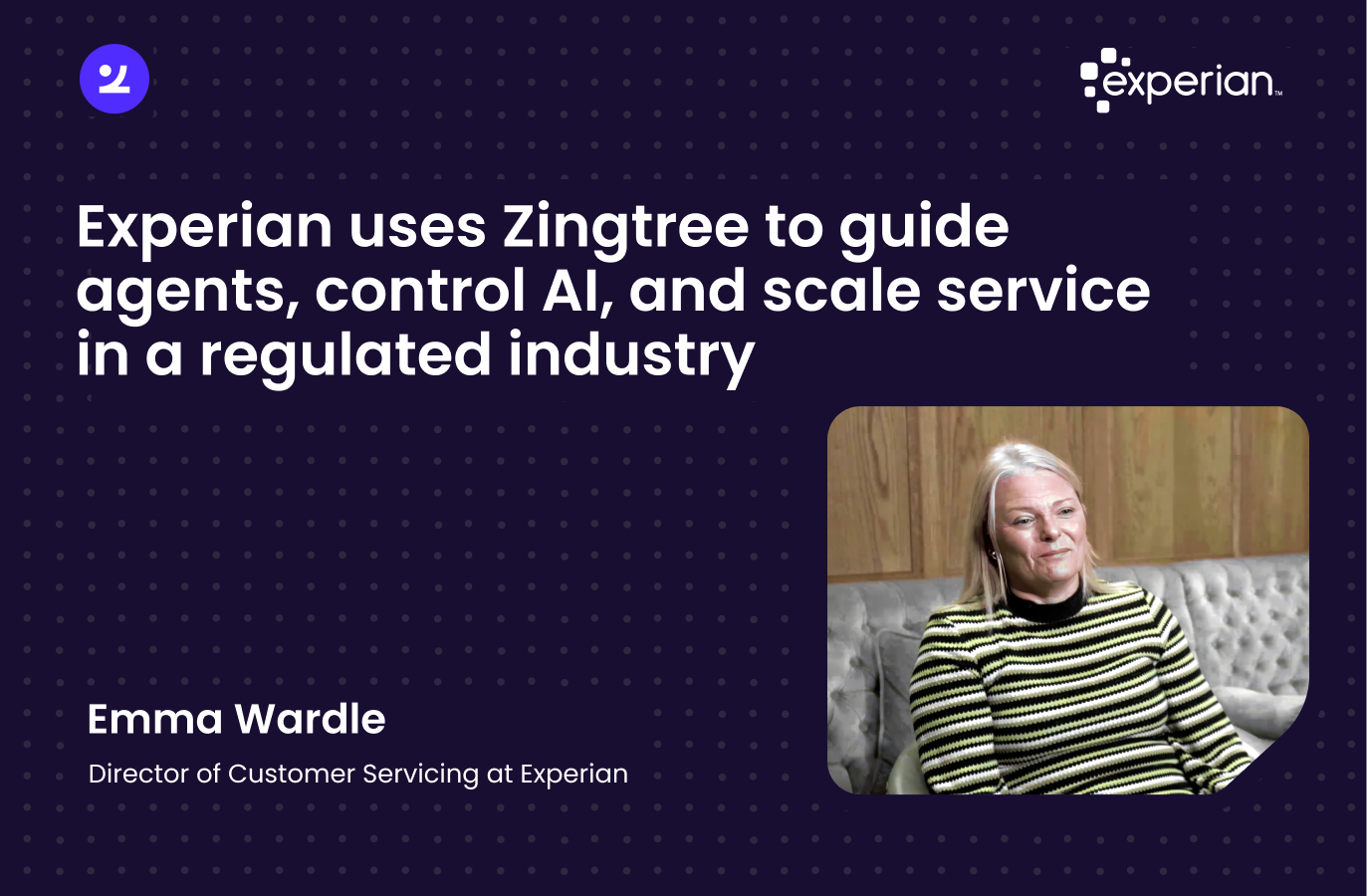
Emma Wardle, Head of Customer Servicing at Experian, shares how her team uses Zingtree to guide agents through complex processes, deploy AI responsibly, and balance automation with human empathy.
.webp)

10 min read

.svg)
.svg)
.svg)
Emma Wardle shares how Experian is approaching AI implementation with a focus on compliance, control, and consumer outcomes. From agent enablement to customer self-service, Emma unpacks the real-world challenges and opportunities of using AI in a regulated financial environment — and why augmenting human service is the key to long-term success.
AMA with Emma Wardle
How is Experian using Zingtree today?
Our relationship with Zingtree started about four years ago, and we’ve been using it primarily as an agent help tool — helping our contact center teams navigate complex financial processes in real time.
Because of the success on the agent-facing side, we’re now exploring how to extend that logic to customers directly, using deterministic AI. We’re early in that journey, but we clearly see the potential.
What feels most promising — and what gives you pause — about using AI in CX?
What excites me is AI’s ability to:
- Remove basic, labor-intensive processes
- Enable more personalized interactions
- Support agents and consumers at scale
But what gives me pause is the idea that AI might replace the human touch. People still want to deal with people. The goal should be augmenting human interaction, not replacing it. That means:
- Automating the right things
- Letting humans focus on what only they can do — empathy, nuance, care
How should companies evolve the relationship between automation and human agents?
It has to be a blended model.
Trying to fully automate every process will always feel… artificial. Instead, we need to ask:
- Which process steps make sense for AI?
- Which require human skill and empathy?
- How do we blend the two?
That’s often hard to explain to execs who are chasing full automation. But CX isn’t binary — the magic is in knowing when to automate and when to hand off.
What does responsible AI look like in a regulated environment?
In regulated industries, nothing goes live unless it’s safe, tested, and controlled.
We think first about:
- What outcome is the consumer expecting?
- Can the AI deliver it safely and accurately?
- Have we done the right testing to know?
Even after deployment, we need monitoring and control mechanisms:
- What if AI goes off track?
- What if users behave in unexpected ways?
Responsible AI means rigor up front — and strong controls after launch.
Many execs are hesitant about AI. What would need to be true for you to move forward confidently?
I’d say… we already are.
We’re moving forward, but in a measured, well-controlled way — small steps with a large vision. We’re learning as the tech evolves. And we’re confident because we’ve put the right controls in place.
It’s not about being all-in or sitting out. It’s about evolving responsibly.
Over the next 6–18 months, what feels realistic to pursue with AI and automation?
We’re looking at AI in two main areas:
- Agent enablement: How can AI give our agents real-time information so they can personalize better and support consumers faster?
- Customer self-service: Many of our customers use Experian for free. There’s no direct revenue stream tied to that support. So how do we deliver a great experience efficiently?
That means:
- Letting customers get what they need and move on with their day
- Automating what should be automated
- Reserving human time for high-impact moments
It’s about enabling people to do what people do best — and making the simple things simple.

.jpg)