Back to Blog
How Corpay uses Zingtree to bring structure, speed, and AI to high-stakes CX
Corpay’s CX and Ops teams deal with high-stakes, high-complexity workflows every day. With Zingtree, they’ve transformed scattered processes and manual analysis into real-time, structured decision flows – built for AI, governed by logic, and fully in their control.
.webp)

10 min read

.svg)
.svg)
.svg)
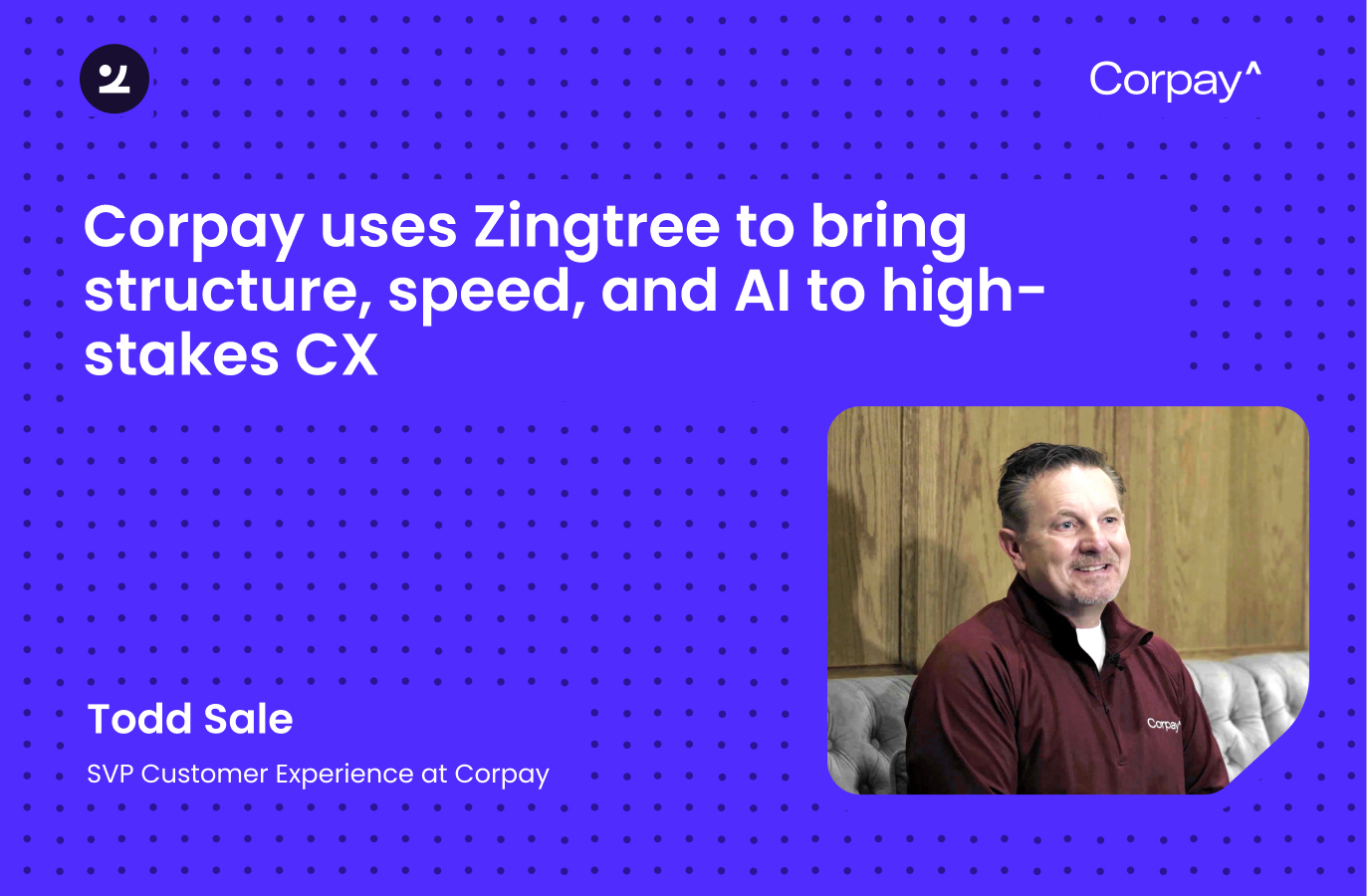
Todd Sale, SVP, Operations & Customer Experience at Corpay, shares how his team has evolved from skepticism to strategic adoption — and how they’re using Zingtree’s platform to create guardrails, accelerate change, and safely deploy AI in high-stakes financial workflows. From documentation to decisioning, Todd breaks down how Corpay is operationalizing AI without compromising control.
AMA with Todd Sale
How do you describe what Zingtree does?
Zingtree takes complex business process and puts it in real time on the screen for associates trying to manage difficult use cases.
What makes it special is that you can automate steps, access dense data, and extract insights—all inside that process layer. Now with AI, things are accelerating. We’re seeing how better decisions and outcomes can be driven by automation that’s grounded in logic.
How has customer complexity changed in the last few years?
Expectations are higher. In the past, we used to dismiss exceptions as edge cases. Now the mindset is: you should’ve known about the edge case—and you should’ve addressed it proactively.
That shift in expectations, especially in an AI-saturated world, is probably the biggest change we’ve seen.
What has changed in your relationship with Zingtree over the last few years?
At first, I was probably the least interested in Zingtree. I saw it as another desktop tool, and I was trying to de-complex the environment. But I paused and took it in.
Now, we’ve transformed how we handle process:
- What used to live in someone’s head as “institutional knowledge” now lives in Zingtree.
- Change management used to be scary—now we just say, “build a tree.”
- We go to market faster, but expectations have gone up too. What used to take 90 days is now expected in a week.
Zingtree has completely changed how we document, scale, and adapt process.
Why was now the right time to invest in AI automation?
A year ago, there was appetite, but not clarity. Everyone was interested in AI, but few had a real use case with provable ROI.
Then something clicked. We stopped thinking about AI in terms of front-line chat. We looked at business process. Where were our people under-informed? Where was dense data available but underutilized?
That’s where the real opportunity emerged: contextual delivery of the right data, at the right time, in the right texture—so that people can make better decisions, in the moment.
With so much noise in the AI space, what should CX leaders focus on?
You’ve got to pick a valuable lane and go deep.
For us, that meant less focus on chat or conversation automation, and more on:
- Presenting data with context
- Improving decision-making
- Driving better business outcomes
We also think there’s a fraud use case hiding in here that we haven’t quite unlocked—but it’s coming.
How does Zingtree’s logic and control philosophy align with your AI strategy?
Zingtree’s model fits us perfectly.
In the past, our guardrails lived in people’s heads. Now, we can define them inside a tool and present them consistently to:
- Associates
- Vendors
- Customers
And now with AI, Zingtree gives us control over:
- Our own OpenAI enterprise license
- Our own prompt engineering
- Our own data boundaries
We can even wall off the AI, keeping it within our systems so it doesn’t hallucinate or go rogue.
What was the first big manual process you hoped to automate with Zingtree AI?
We wanted to eliminate the need for manual analysis across multiple systems. Our associates had to:
- Pull data from 2–3 platforms
- Drop it into a spreadsheet
- Run pivot tables
- Analyze trends
Now, we’re bringing that broader transactional view directly to the desktop—without making our people do all that heavy lifting.
What metrics do you expect to improve with AI Actions?
The obvious ones:
- Handle time
- Speed to resolution
- Agent satisfaction
But the real value is in:
- Better outcomes
- Less risk
- More value to customers
If I’m in front of execs, that’s what I’m showing: AI as a driver of strategic value—not just tactical efficiency.
What’s next for AI at Corpay?
We’ll keep expanding:
- More agent assist tools
- More customer-facing flows
- More textual delivery of insights
But where I see real untapped value is in putting AI in front of Sales. Right now, Sales doesn’t have servicing tools—and that’s by design. But imagine equipping Sales with the same depth of insight our CX teams get, just framed for their conversations. We’re not there yet—but we will be.
How do you see Zingtree’s logic layer working with LLMs?
It’s use case-specific. But our approach is:
- Challenge every process step.
- Ask: Is this step informed? Are we missing edge cases?
- Use AI to surface nuance without overwhelming the interface.
Zingtree’s logic layer lets us keep the front-end clean while using AI to make the backend smarter.
Where do you not want AI making decisions?
External-facing AI still worries me. At least until we get strong guardrails in place.
If a use case is low-risk, maybe you take a chance. But for anything high-stakes? You better have guardrails and business rules in place—or don’t do it.
Right now, we’re focused on AI for internal users. That’s where we can add the most value safely—by informing smart, capable people with deeper, better data.

.png)
