AI where you want reasoning. Control where you need it.
Introducing Zing Engine, the first agentic-deterministic hybrid engine.
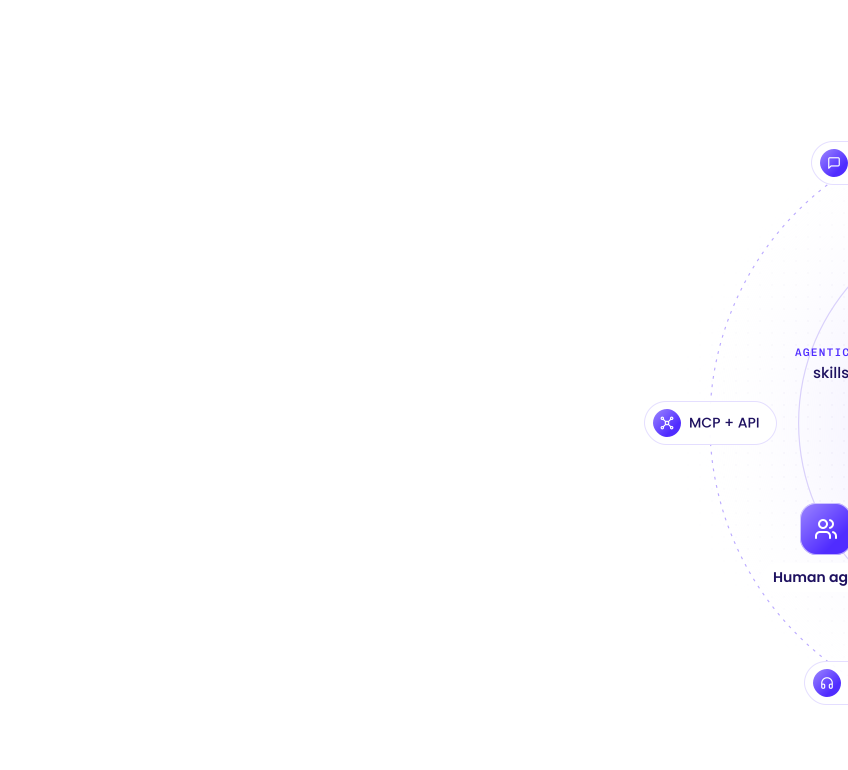
Powered by an agentic-deterministic hybrid engine
Only Zing Engine harnesses both deterministic control and agentic reasoning. It shifts autonomy mid-conversation: reads your rules, brings in the AI for the language and the judgment, checks every step, acts in your systems, and records the outcome.
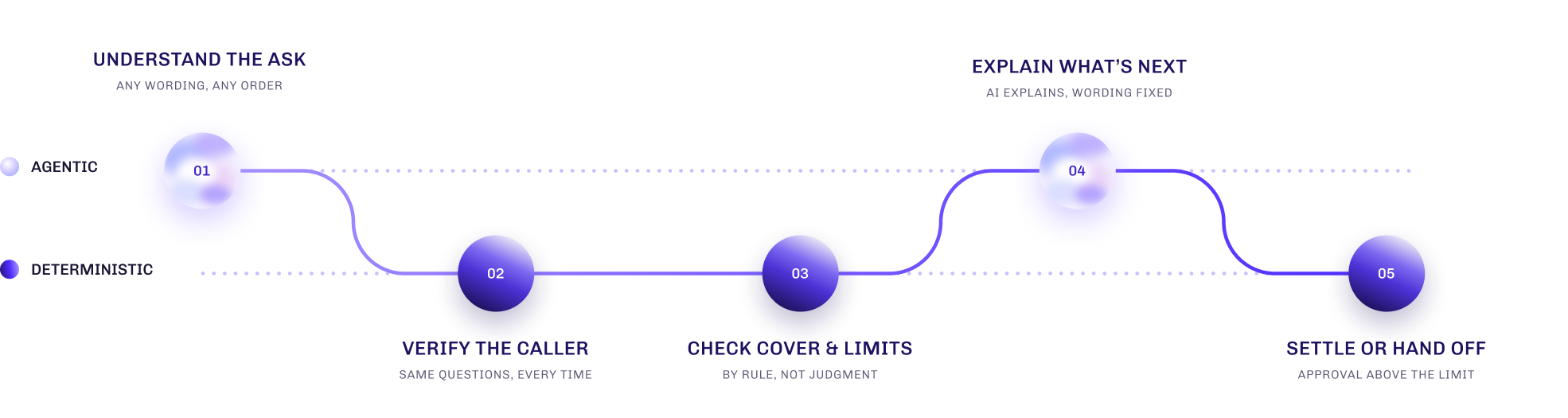
One conversation, four steps
A claims dispute, from the first message to a resolved case.
Every step is checked and recorded
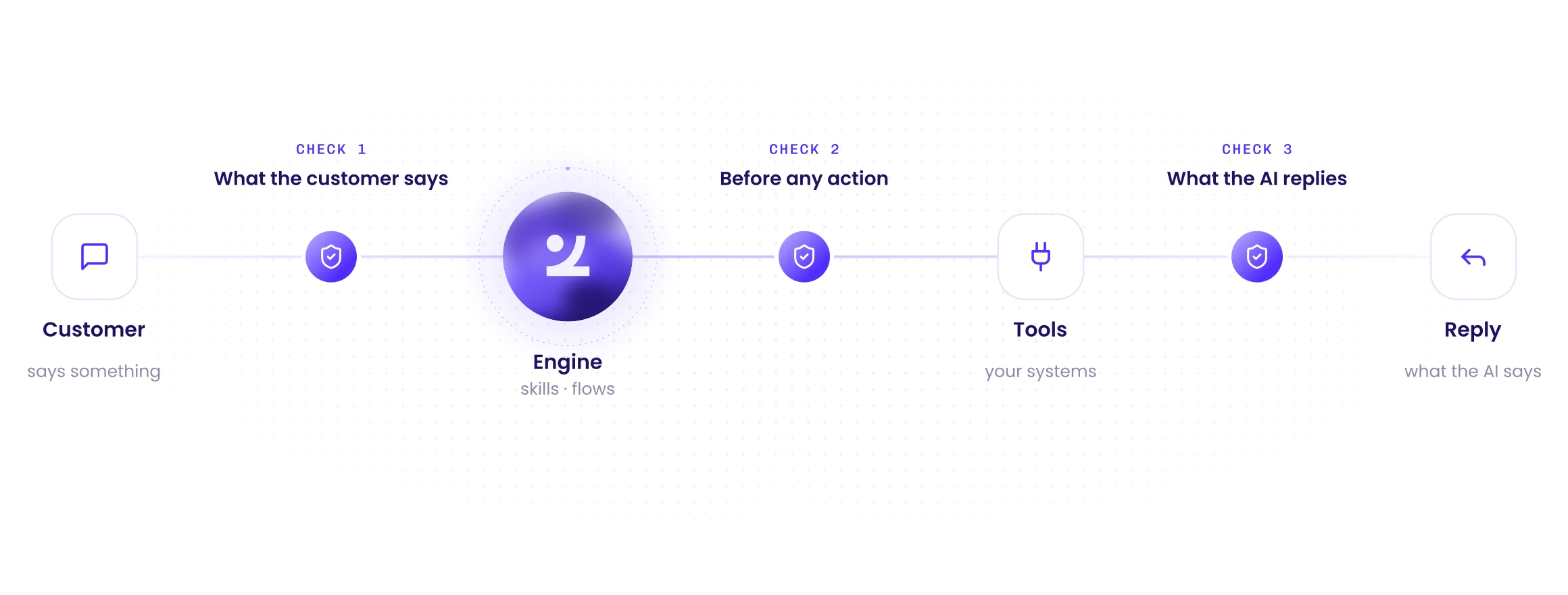
Guardrails run outside the AI at three points: what the customer says, what the engine is about to do, what the AI replies. Each check ends one way: allow, modify, block or escalate. Everything goes on the record.
Guardrails
Rules that run outside the AI: masking, locked wording, limits, verification before sensitive steps.
Observability
Every conversation, step and decision, live and searchable.
Evals
Each version is tested on sample conversations before a person approves it.
Auditability
Query the outcome and the facts. Replay the full path. Kept for every version.
Connected to the systems you run
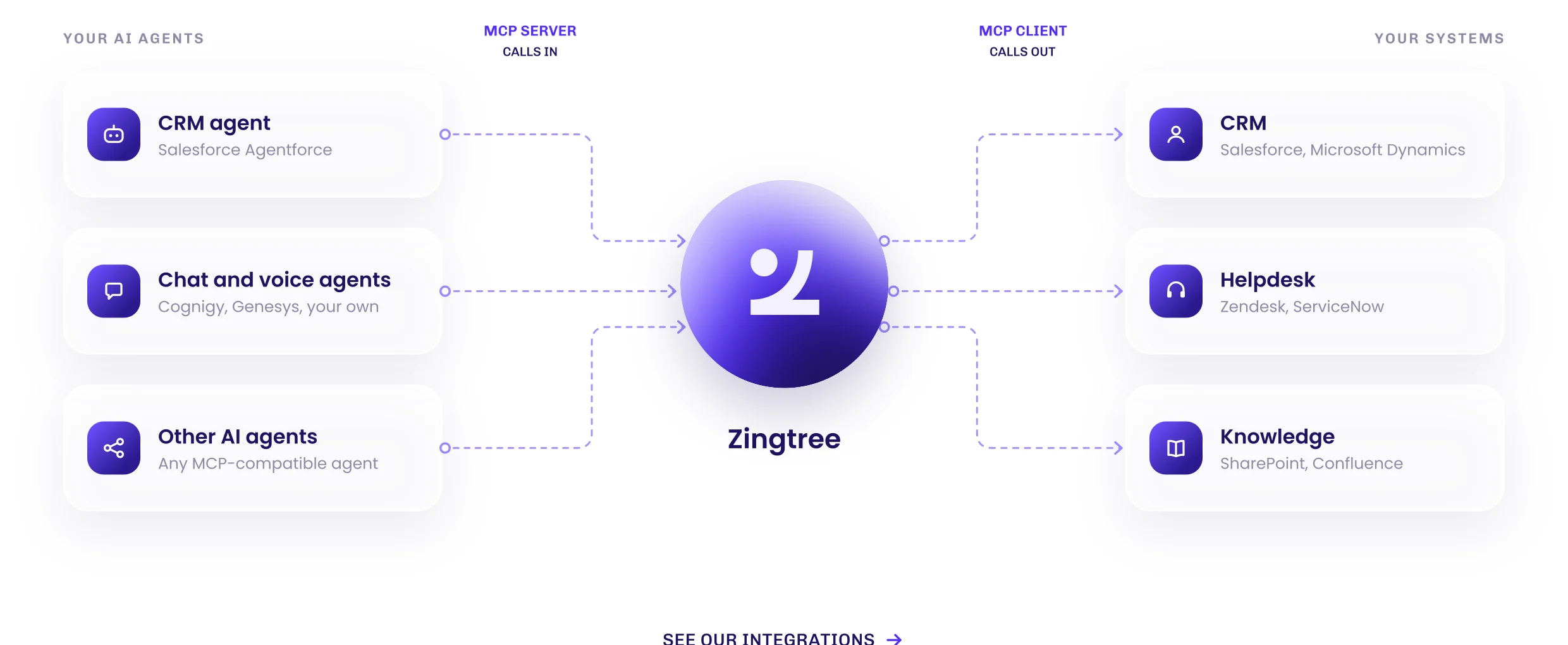
Zingtree speaks MCP in both directions. Your AI agents call in; the engine calls out to your CRM, help desk and knowledge. IT sets a connection up once, and every process agent uses it.
Built for work you need to explain later
Keep the rules, permissions, and audit history behind every task when customer data, money, policy, or compliance is involved.





One engine.
Three ways to put it to work.
Every Zingtree product runs on Zing Engine, under the same rules. Pick the one that matches where the work happens.
Self-Service
Customers resolve on their own, in chat, voice or email. The engine runs the whole conversation.
Learn more about Self-ServiceCopilot
The next step for your human agent, in the same thread. The engine drafts, checks and proposes; the agent stays in charge.
Learn more about CopilotCX Operations
Work done in your systems before and after the conversation, with no chat needed.
Learn more about CX OperationsQuestions about Zing Engine
The questions buyers ask before a demo, answered straight.
An engine that runs agentic steps and deterministic steps in the same conversation. You decide per step, when you build the process agent, which one does the work: skills handle the talking, flows handle the steps that must be exact.
Whatever your tools allow, and nothing else: look up a customer, freeze a card, issue a refund, update a case. Every action runs through allow-listed connectors, with your sign-in, and is recorded.
A sequence of steps the engine runs exactly as written, outside the AI: verify identity, then freeze the card, then refund up to the limit. The order, the checks and any locked wording are fixed. The AI can ask and explain around them; it cannot reorder or skip them.
The model is one component inside the engine. Zing Engine works with more than one provider, and you can change models without rewriting your skills or flows.
A process agent handles one business outcome end-to-end, like refunds, across Self-Service, Copilot and CX Operations. It is built from skills, tools, guardrails and flows.
Yes. SOPs, policies and Zingtree Classic trees are the starting point. Quick Start converts what you have into a first version to edit.
No. Flows run in the engine, outside the AI. The AI can ask, explain and propose; it cannot move past a step the flow has not accepted.
Bring one process. We’ll show you how Zing Engine runs it.
In a demo we take one of your processes through every step: what the skills handle, what your flows control, what it does in your systems, and where people step in.